The best Perplexity alternatives in 2026
Perplexity is good at what it does. People leave for four reasons: privacy defaults, hidden model choice, search-box-not-workbench, cost. Best answer to each.

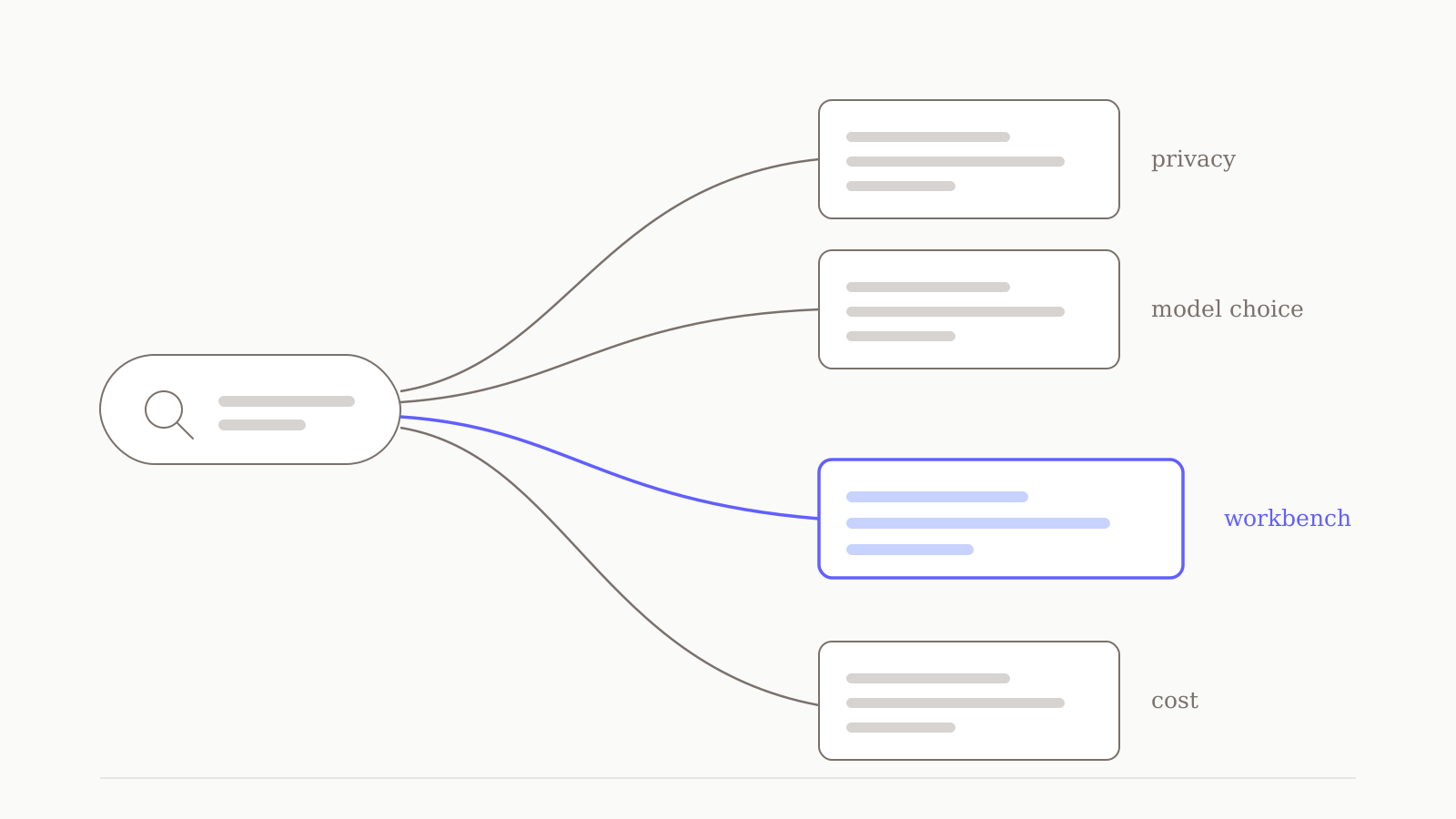
Perplexity is genuinely good at the job it was built for: ask a research question, get a synthesised answer where every claim carries an inline citation you can click. If that is what you need, it remains one of the best tools available and you probably should not switch. But people do leave it, and in our experience they leave for four specific and quite different reasons. The right alternative depends entirely on which reason is yours — so this piece is organised by the reason, not by a ranked list.
Fair warning on one thing this post deliberately does not do: it does not award scores out of ten. Feature sets and pricing on all of these tools move fast enough that a scoreboard would be stale within a month. The comparisons below stick to things that are structurally true and verifiable, and link to the source when a claim is a matter of published policy.
Reason 1: the privacy default
This is the reason that surprises people most, so it goes first.
Perplexity's own help centre states that for Free, Pro, and Max users, "AI Data Retention is enabled by default," and that some data "may be used to train AI models and improve search quality, unless you opt out through Account Settings" (Perplexity Help Centre). Perplexity Enterprise data, by contrast, is "never" used for AI training.
Before you switch on this basis, know that this is not a Perplexity problem — it is an industry-wide default. ChatGPT trains on personal-plan chats by default. Gemini warns you outright that human reviewers may read your chats. Claude now asks consumer users to choose, with a five-year retention window attached to "yes." We went through every vendor's published policy in which AI chatbots train on your conversations.
So switching from Perplexity to another consumer assistant will not fix this by itself. Two things actually will:
- Opt out where you are. Account Settings → AI Data Retention → off. Thirty seconds. If you like Perplexity otherwise, this is the whole fix.
- Use a tool built on the API tier, where no-training is the default rather than a setting you have to discover. That is the structural version of the fix, and it is the one we built oran.chat on.
Reason 2: you cannot see or choose the model
Perplexity's design hides the model behind the search box. For most questions that is a feature — you should not have to know what a model is to ask a question. But if you have developed a sense of which model you trust for which kind of question, the abstraction starts to chafe. You cannot tell whether a disappointing answer was a bad model choice or a genuinely hard question.
If that is the itch, you want a tool that either shows you the model or lets you pick it:
- ChatGPT or Claude directly — you know exactly what answered, because you chose it.
- OpenRouter — the developer answer. One API across a very large model catalogue; the most control available, at the cost of building your own interface around it.
- oran.chat — sits deliberately between the two. It routes each question to the model it judges best, but it shows you which one it picked and why, on every reply. The pick is automatic; the transparency is not optional.
That middle position is our actual bet, so treat it as an argument rather than a neutral finding: we think the interesting design is not "hide the model" or "make the user choose every time," but "choose well and show your work."
Reason 3: you wanted a workbench, not a search box
This is the most common reason, and it is really a disagreement about what happens after the answer arrives.
Perplexity is search-shaped. You ask, you get a cited answer, and the interaction is essentially complete. That is a clean fit for research where the answer is the deliverable. It is a poor fit when the answer is step one of eight — when you want to take the result, argue with it, feed it a document, rewrite it in your own voice, and branch off to try a different approach without losing the first one.
For that, you want a chat workbench:
- ChatGPT — the strongest all-rounder, and search is built in when it decides browsing is warranted.
- Claude — the best of these at reading long documents and staying coherent across a long thread.
- oran.chat — built specifically for the multi-step case: your custom instructions prepend every chat regardless of which model answers, regenerating creates a branch rather than overwriting the previous answer, and web search with inline citations is on for everyone by default.
If your work is genuinely "look something up, cite it, move on," ignore this section entirely — Perplexity is better at that than any of the above, and switching would be a downgrade.
Reason 4: cost, and too many subscriptions
The AI subscription stack has a way of quietly reaching $60–80 a month: one for search, one for chat, one for coding. If you are hunting a Perplexity alternative because you are trying to collapse that stack rather than because Perplexity did something wrong, the question is not "what replaces Perplexity" but "what replaces three tools."
That is a different piece of analysis, and we wrote it: how to consolidate your AI subscriptions. The short version is that most people are paying for three tools to get one capability each, and the capabilities overlap far more than the pricing pages suggest.
Choosing, in one table
| If your reason is… | The honest answer is… |
|---|---|
| Privacy defaults | Opt out in Perplexity first. If you want it structural, use an API-tier tool. |
| Can't see the model | ChatGPT/Claude directly, OpenRouter for control, oran.chat for routing with the pick shown |
| Want a workbench | ChatGPT, Claude, or oran.chat — not a search box |
| Cost / too many subs | Consolidate; don't just swap one $20 tool for another |
| Research you'll cite | Stay on Perplexity. It's the best at this. |
That last row is the one most "alternatives" posts will not tell you, because it does not help them sell anything. It is still true.
Where oran.chat actually fits — and where it doesn't
We build oran.chat, so read this section with the appropriate suspicion.
It is a decent Perplexity alternative if your reason is #2, #3, or #4: you want the model choice made for you but shown to you, you want a workbench rather than a search box, and you want web search with citations included rather than as a separate subscription. It runs on the OpenAI and Anthropic API tier, so your conversations are not training data by default. The free tier is 10 messages a day; paid starts at $5/month.
It is a bad Perplexity alternative if your reason is #1-as-a-compliance-requirement. We have no DPA, no subprocessor list, no SOC 2 report, and no team plan. Perplexity Enterprise has all of those. If you are buying for an organisation with a procurement process, buy theirs, not ours.
And if what you actually love about Perplexity is the citation-first research surface — the thing it is genuinely best in class at — no tool on this list beats it, including ours. We compared that surface head-to-head in Perplexity vs ChatGPT search vs Google AI Overviews.
Where this fits
This is the AI-search entry in our Comparisons cluster. The pillar for the wider "what should I use instead" question is The 7 best ChatGPT alternatives in 2026 (tested). If privacy is what brought you here, which AI chatbots train on your conversations has each vendor's setting and where to find it. You can try oran.chat free without a card.