Five prompt patterns I keep coming back to
Five reusable prompt structures with before-and-after examples — the ones we use ourselves often enough to memorize. Not the generic 'act as a' list.

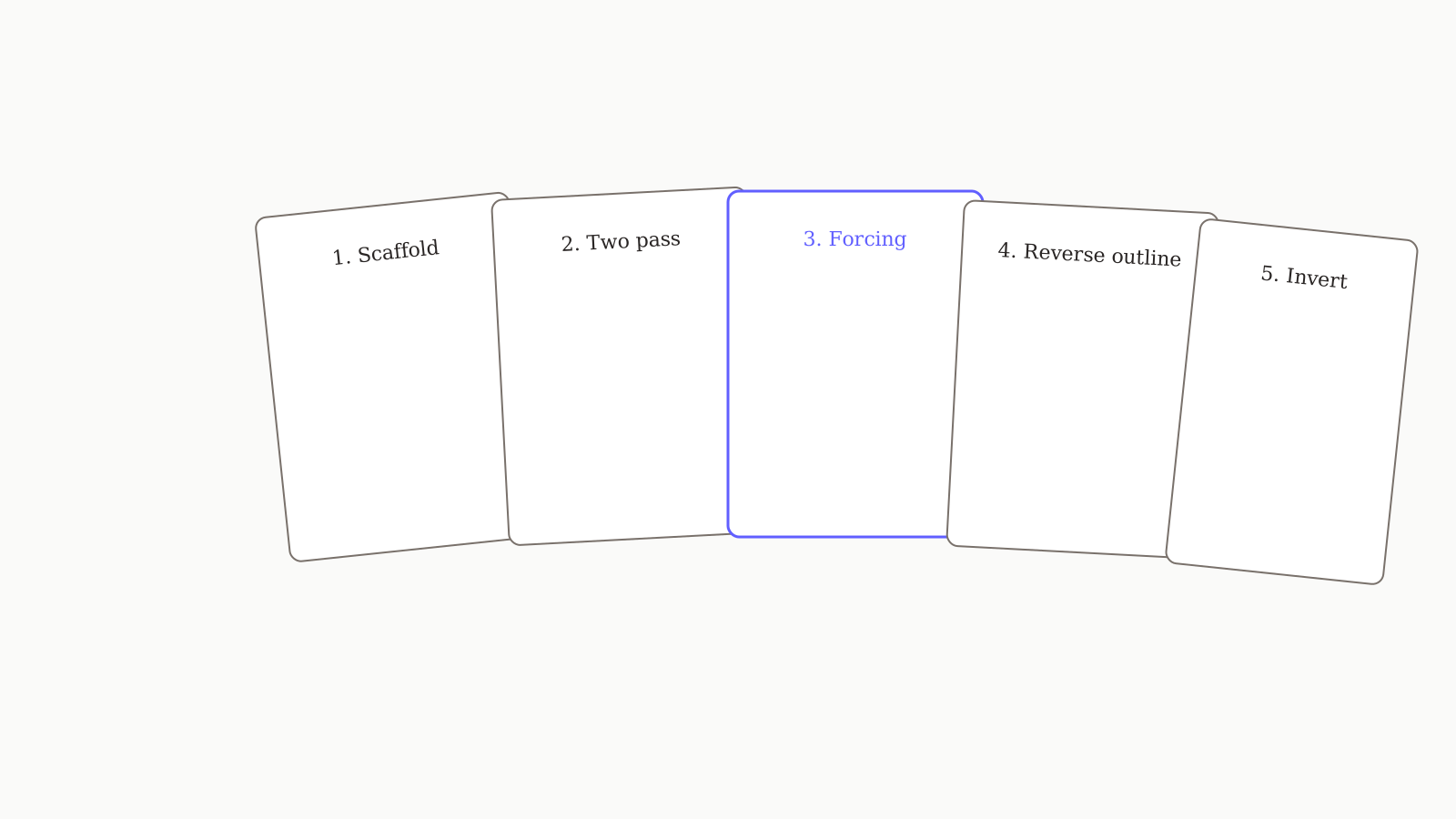
Every "100 ChatGPT prompts" article repeats the same generic openers. The five patterns below are the ones we actually use often enough that we've memorized them — each one has a job, a structural shape, and a before-and-after example. None of them are "act as a senior X". They're better than that.
1. The scaffolded ask
Job: Get a useful first draft instead of a generic one.
Structure:
I'm trying to <outcome>.
The audience is <who>.
The constraints are <list>.
Here's what good looks like: <example or rubric>.
Now do it.
Before: "Write a launch email for our new feature."
After: "I'm trying to drive trial signups for our new branching feature. The audience is existing free-tier users who haven't upgraded. The constraints are: no marketing-speak, 150 words max, one clear ask. Good looks like the Stripe newsletter — direct, specific, ends with one action. Now write the email."
The second prompt produces something usable on the first turn. The first prompt produces something generic that takes three follow-ups to fix.
2. The two-pass review
Job: Get edits that catch real problems, not stylistic preferences.
Structure:
Read this twice.

First pass: argument. What is this saying? What does it want
the reader to do? Where does the argument get muddled?

Second pass: line-level clarity. Flag any sentence trying to
do more than one thing, any jargon a reader could miss, any
claim a reader could doubt.

Return both passes separately. Do not rewrite.
Before: "Edit this for me."
After: Use the structure above. The model gives you two distinct passes — one strategic, one tactical — instead of mixing them into a confusing flat list.
3. The forcing function
Job: Get the model to commit to a position instead of hedging.
Structure:
You must pick one. No "it depends". No "all are valid".
Pick the one you'd recommend to a friend who's about to <action>,
and defend the choice in three sentences.
Before: "Should I use Claude or GPT?"
After: "I'm a writer who works mostly with long documents. You must pick one — Claude or GPT — for me to subscribe to for the next year. No 'it depends'. Pick one, defend it in three sentences."
The model will hedge by default. The forcing function gets a real recommendation.
4. The reverse outline
Job: Diagnose whether a piece of writing actually says what it thinks it says.
Structure:
Read the piece below. Write a one-line summary of each paragraph.
Then list the three claims the piece is making, ranked by how
strongly the evidence supports each.
Before: "What do you think of this draft?"
After: Apply the structure. You get back the actual skeleton of your piece. Most of the time it reveals that paragraph 4 is doing nothing, claim 2 has weak evidence, and you accidentally made claim 3 a side note when it should be the headline.
5. The constraint inversion
Job: Stress-test a decision by forcing the model to argue against it.
Structure:
I've decided to <decision>. Argue against this decision as
forcefully as you can. Use the strongest counterarguments you
can find. Don't soften the critique.
Before: "What do you think of my plan to do X?"
After: "I've decided to launch the feature without a free tier. Argue against this decision as forcefully as you can. Don't soften the critique."
Models are trained to be helpful and tend to defer to your stated direction. The constraint inversion forces them past the defer-instinct.
Putting them together
The patterns compose. A common combination: use the scaffolded ask to produce a draft, use the two-pass review to edit it, use the reverse outline to verify the argument is clear, and use the constraint inversion to stress-test it before shipping.
If you keep one system prompt across all your models, these patterns land identically in GPT-5, Claude 4.7, and Gemini 2.5 Pro. Use oran.chat if you want to switch model per pattern (the constraint inversion lands hardest in GPT-5, for what that's worth).
More structural prompting work in Playbooks.